 (EN)
(EN)
 (ES)
(ES)
 (IT)
(IT)

Dicastery for Interreligious Dialogue
The Dicastery for Interreligious Dialogue is the Vatican body responsible for promoting respect, mutual understanding, and collaboration between Catholics and followers of other non-Christian religious traditions, with the exception of Judaism, which falls under the jurisdiction of the Dicastery for Promoting Christian Unity
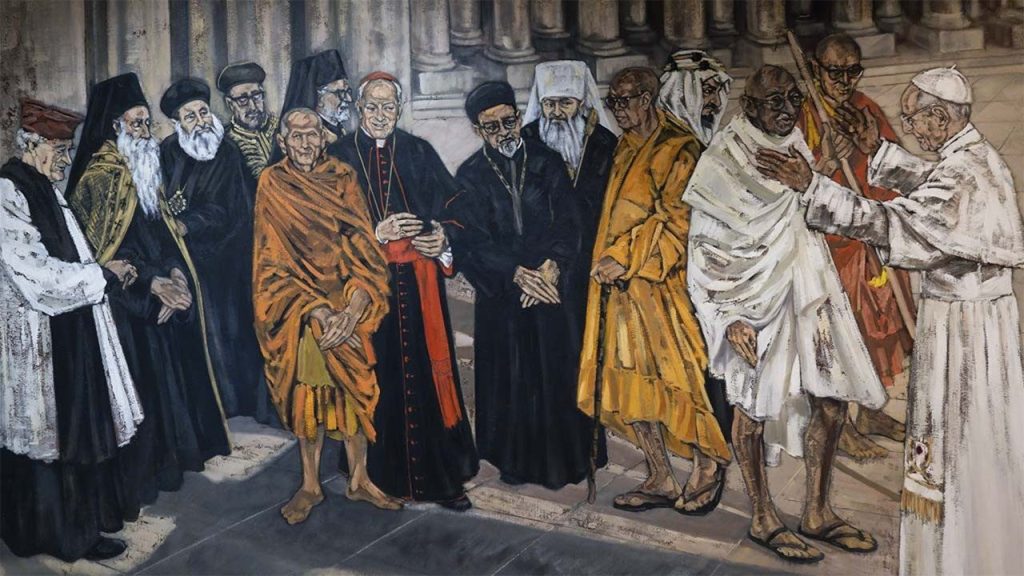

It is based on the method and criteria for dialogue established by the Second Vatican Council, which led, in 2019, to the fundamental chapter on human fraternity. Since January 21, 2025, it has been led by Cardinal George Jacob Koovakad , with Monsignor Indunil Janakaratne Kodithuwakku Kankanamalage as secretary .
A book opened 60 years ago by the Second Vatican Council, which with the teachings of Pope Francis has reached the chapter on human fraternity, exemplified in the Document on Human Fraternity signed in Abu Dhabi on February 4, 2019.
Historical background
As the Secretariat for Non-Christians, it was instituted by Pope Paul VI on May 19, 1964, through the Brief Progrediente Concilio , even before the promulgation of the conciliar Declaration Nostra Aetate (1965) and the closing of the Second Vatican Council.
In 1974, within the Dicastery, the Commission for Religious Relations with Muslims was established. In 1988, with the Apostolic Constitution Pastor Bonus of John Paul II, the Secretariat became the Pontifical Council for Interreligious Dialogue , a more inclusive name.
With the Apostolic Constitution Praedicate Evangelium , of March 19, 2022, it was renamed the Dicastery for Interreligious Dialogue .
Skills
According to the Constitution Praedicate Evangelium , the Dicastery works to ensure that dialogue with followers of other religions develops appropriately, with an attitude of listening, esteem and respect, while promoting peace, freedom, social justice, the protection and safeguarding of creation, as well as spiritual and moral values.
Recognizing that interreligious dialogue is realized through action, theological exchange, and spiritual experience, it fosters a genuine search for God among all people. It serves the Church in its broad mission of dialogue, collaborating with the bishops of local Churches, especially through the Episcopal Commissions for Interreligious Dialogue.

It focuses on dialogue among Christians regarding their relations with followers of other religions. It maintains ongoing relations with the equivalent Office for Interreligious Dialogue of the World Council of Churches and collaborates on initiatives for the study and promotion of dialogue.
It supports relationships and events that foster a spirit of dialogue and fraternity with diverse groups representing other religious traditions. It encourages the study of religions among Christians and invites those of other faiths to deepen their study of Christianity. It promotes the formation of individuals committed to dialogue, both intellectually and in their daily lives.
Especially with Pope Francis, his mission has become a priority for the Church, as evidenced by international trips, from Abu Dhabi in February 2019 to Iraq in 2021, as a sign of “human fraternity”, to his last and longest trip to Asia and Oceania in September 2024, where he blessed the “tunnel of friendship” that connects the mosque to the cathedral in Jakarta, Indonesia.
The Dicastery has the tradition of sending auspicious messages to various religious traditions, such as those addressed to Muslims on the occasion of the month of Ramadan, to Buddhists for the Festival of Vesakh or Hanamatsuri, to Hindus on the occasion of Deepavali, to Jain communities on the occasion of Mahavir Jayanti, and to Sikh communities on the occasion of Prakash Diwas.
The impetus given by the Popes has not been lacking. We recall, for example, the World Day of Prayer for Peace, established in 1986 in Assisi by Saint John Paul II, with 50 representatives of Christian communities and 60 of other religions, which was a milestone in interreligious dialogue. This was followed, on its 25th anniversary in 2011, by a second meeting in Assisi, convened by Pope Benedict XVI, in which around 180 representatives of various religions participated.
The Document on Human Fraternity for World Peace and Living Together , signed on February 4, 2019 in Abu Dhabi by Pope Francis and the Grand Imam of Al-Azhar, Ahmad Al-Tayyeb, and the 2020 Encyclical Fratelli Tutti , are inscribed in the conciliar furrow and in the culture of encounter developed in these decades.
Nostra Aetate Foundation
The Nostra Aetate Foundation , established in 1990 and based at the same Dicastery, awards scholarships to young people of other faiths already engaged in dialogue, residing in foreign countries, who wish to deepen their knowledge of Christianity at the pontifical academic institutions in Rome. Upon completion of their studies, these young people return to their countries and rejoin activities related to interreligious dialogue, having acquired a greater understanding of the Christian faith.
The Foundation also provides grants to support local initiatives aimed at promoting interfaith dialogue. From an economic standpoint, the Foundation is autonomous and self-funded.
(Translation made while maintaining fidelity to the original text published in Vatican News )
- State Secretariat
- Dicastery for the Doctrine of the Faith
- Dicastery for Bishops
- Dicastery for the Clergy
- Dicastery for the Service of Charity
- Dicastery for Institutes of Consecrated Life and Societies of Apostolic Life
- Dicastery for the Causes of Saints
- The Dicastery for Promoting Christian Unity
- Dicastery for Interreligious Dialogue

Exaudi Staff
What is Exaudi News? Exaudi News is an international Catholic media outlet that informs, shapes, and transforms daily in Spanish, English, and Italian. Through news, analytical articles, and live broadcasts of the Pope's events, Exaudi seeks to strengthen Christian unity and contribute to the evangelization of the world, always guided by the Church's social doctrine. We work to bring Christian truth and values to every corner of the planet. Help us transform the world with Exaudi! At Exaudi, we believe that evangelization and quality information can change lives. To continue our mission and expand our reach, we need your help. In addition, we are looking for committed people to join our team. With your support, we will reach more people, spread the message of Christ, and strengthen Christian unity. Will you join our mission? For more information on how to collaborate, visit Exaudi.org or contact us directly: [email protected] Exaudi: Informs, educates, and transforms.
Related
Pasolini: A free life consists of always loving and enduring pain without being defeated
Exaudi Staff
27 March, 2026
4 min
The Dicastery for Promoting Christian Unity
Exaudi Staff
26 March, 2026
4 min
Pope Leo XIV receives the King and Queen of Spain in audience
Exaudi Staff
20 March, 2026
2 min
The Christian mission is born from a transformed life
Exaudi Staff
20 March, 2026
2 min