(EN)
(EN)
 (ES)
(ES)
 (IT)
(IT)

Being for Others: Saint John Paul II’s Vision of the Gift in Creation and Human Relations
Meditation on the Gift
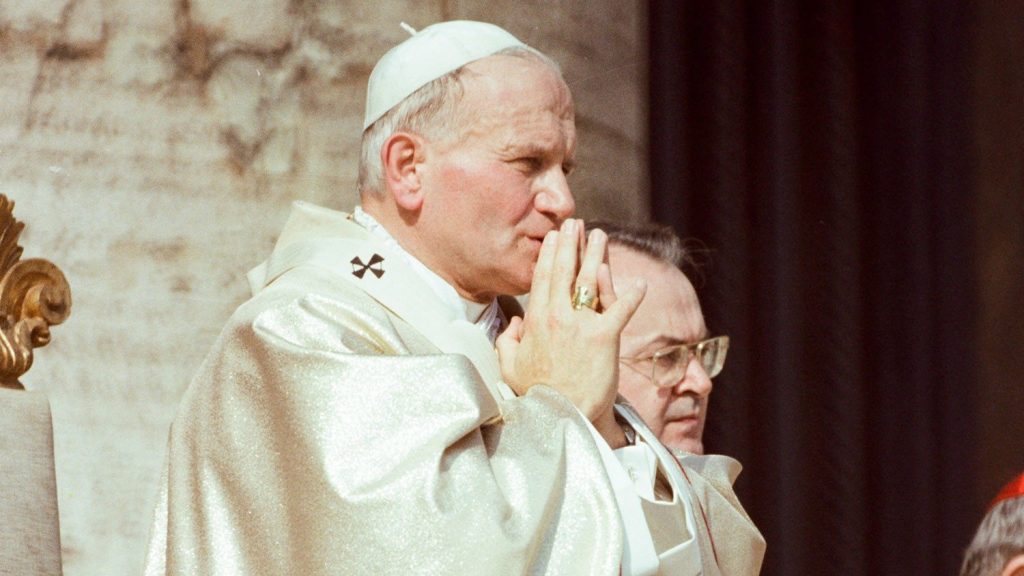

Saint John Paul II wrote this meditation on the gift in 1994. It was published posthumously in 2006. A profound text on the creational reality of the gift and of giving, manifested in a particular way in the relational condition of creatures. God creates the world and entrusts it to humankind for its benefit, respecting the inherent good of each creature, whether animate or inanimate. “If man is good to them,” says the Holy Father, “if he refrains from causing them unnecessary harm or from exploiting them thoughtlessly, then creation forms a natural environment for man. Creatures become his friends. This not only allows him to survive, but also to find himself.” To good treatment, creation itself responds with goodness, generating a healthy common home.
This harmony with creation is also a meeting place that allows a person to know themselves. What can a rock, a plant, a bird, a feline, the wind, the sun tell a human being? Much, from biological and emotional matters to spiritual depths whose gateway is the capacity for wonder, allowing us to better understand our own finitude and dependence, as well as the capacity for transcendence inherent in the personal being we possess: “God gave the world to man so that man might find God in it, and also so that man might find himself.”
It is in interpersonal relationships that the gift-giving nature of each person is most powerfully manifested. “God,” Saint John Paul II points out, “does indeed give us people: He gives us brothers and sisters in our humanity, beginning with our parents. Then, as we grow, He places more and more new people on the path of our lives [wife, husband]. “In some way, each of these people is a gift to us, and of each one we can say: ‘God gave you to me.’ Being aware of this becomes an enrichment for both of us. (…) Our humanity would be in danger if we were to close ourselves off only in our own particular selves, rejecting the broad horizon that opens up before the eyes of our souls as the years go by.”
Each person, particularly in these deep interpersonal relationships, is a gift, a responsibility we receive to care for, respecting their dignity and uniqueness. They are not a burden, a nuisance, or an obstacle preventing us from developing our longed-for personal project. Rather, our sister, child, parents, spouse, and grandparents are gifts that enrich our personal history, giving it depth and filling it with joy, while also providing the maturity forged in the crucible of suffering, an ingredient in the chiaroscuro of life’s experience. When, at times, the temptation arises to turn a blind eye because we perceive the person only as a burden, remembering that “God gave you to me” reminds us once again that we are beings for others. In this dedication to our neighbor, we find the personal fulfillment and plenitude to which we are called.
Discovering the beauty and goodness of our neighbor (sister, parents, spouse…) in good times and bad is beyond our own strength. We require the added grace of Redemption. This is payment for the debt of sin and, “it is also—and perhaps predominantly—a giving back to humanity and all creation that goodness and beauty which were given in the beginning in the mystery of creation (…). God gives humanity back to itself in a new way through Christ, in whom the full value of the human person, that value which it had in the beginning and which it received with the mystery of creation, is once again made manifest and present.” It is about opening our eyes to this profound reality of the human being entrusted to us, to see the dignity, beauty, and goodness that remains in each person, despite the inevitable flaws in human coexistence.
St. John Paul II’s meditation on the gift of self-giving sets the bar high so that we do not lose sight of our mission: to be “a total gift, a selfless and sincere gift in order to recognize, in every man, the gift that he is, and to thank the Giver for the gift of the human person.”

Francisco Bobadilla
Francisco Bobadilla es profesor principal de la Universidad de Piura, donde dicta clases para el pre-grado y posgrado. Interesado en las Humanidades y en la dimensión ética de la conducta humana. Lector habitual, de cuyas lecturas se nutre en gran parte este blog. Es autor, entre otros, de los libros “Pasión por la Excelencia”, “Empresas con alma”, «Progreso económico y desarrollo humano», «El Código da Vinci: de la ficción a la realidad»; «La disponibilidad de los derechos de la personalidad». Abogado y Master en Derecho Civil por la PUCP, doctor en Derecho por la Universidad de Zaragoza; Licenciado en Ciencias de la Información por la Universidad de Piura. Sus temas: pensamiento político y social, ética y cultura, derechos de la persona.