 (EN)
(EN)
 (ES)
(ES)
 (IT)
(IT)

A Madness of Love
My comfort?: To look at you! My wealth?: To have you! My surprise?: To see you smile!
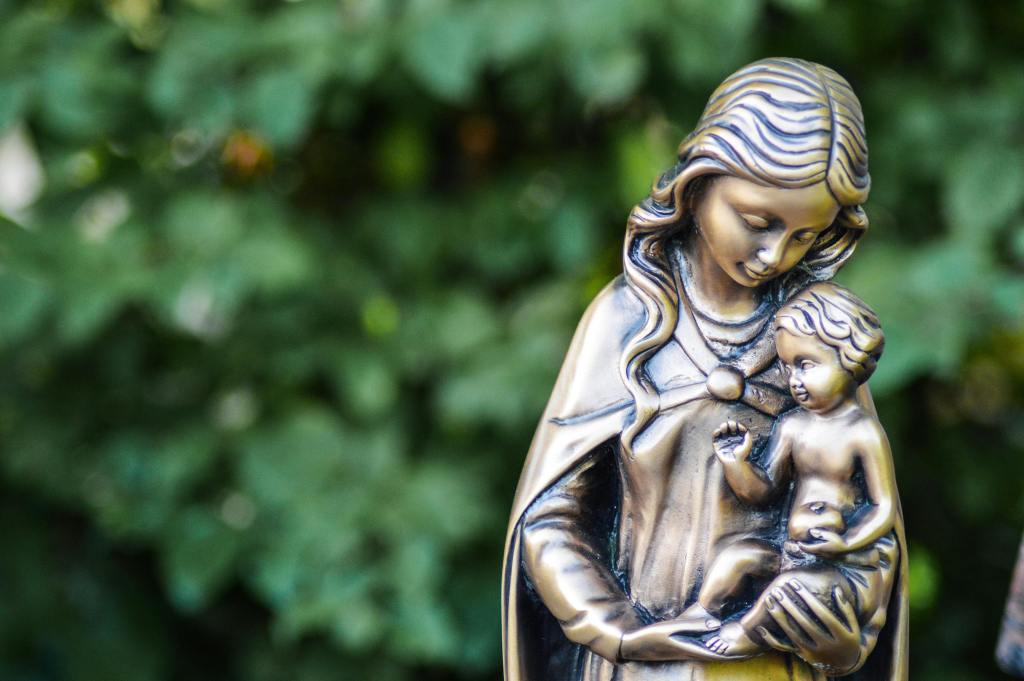

He is not here to impose himself.
It comes to be surrendered.
It is the love of God that comes as a Child: Jesus, the Son of God, born in Bethlehem. Visible and vulnerable, he looks at us and smiles at us, wrapped in swaddling clothes, almost naked, in a humble manger.
That’s where it all begins.
And perhaps, today, we have stopped looking.
Christmas needs to be contemplated anew: without haste, without noise, without the burden of what we think we know. Because what is truly decisive is not imposed; it is offered. It manifests itself in the silent language of a glance.
“Mother, there’s a child at the door…”
It doesn’t burst in by invading. It waits.
And He waits as children wait: without strategies, without power, without shields. He becomes a Child— Jesus of Nazareth, born of Mary in Bethlehem —so that we may not be afraid. So that we may approach Him without justifications, embrace Him with simplicity, and love Him without calculation.
God reduces the distance until it becomes habitable.
“They found no lodging on the road.”
This is not a logistical detail or a pious anecdote. It is a truth that transcends the centuries. The lack of lodging speaks not only of material poverty, but of existential banality. There wasn’t a shortage of houses; there was an excess of occupations. When life is full—of things, plans, consumption, expectations—there is no longer room for what is essential. Not because it isn’t important, but because excess suffocates the inner breath.
Mystery is not part of the competition.
It just shows up and waits.
It is light that illuminates without dazzling, if we do not close our eyes.
The poverty of the manger is not a romantic ideal. It is a demanding paradox: only those who strip themselves bare see clearly. The manger is not misery, it is light. It is the freedom of those who live, having, as if they had nothing. It is the detachment that allows one to take flight without weight on their wings. It is the simplicity that makes room for truth when the unnecessary is no longer an obstacle.
We live in a world that is suspicious of almost everything except what glitters, whether because of its price, its brand, or the social status it confers. We have replaced admiration with the power that comes from “having,” which consumes itself. And, without realizing it, we have confused wealth with accumulation. But wealth, in its deepest sense, is not about having a lot, but about enriching the world we inhabit.
True wealth is measured by the ability to share.
Only those who own a house can invite others.
Only those who possess what is necessary can take care.
Hospitality is one of the noblest gestures that wealth makes possible.
When wealth is not shared, it is corrupted. When it is accumulated without a purpose, it becomes greed, which is not an excess of possessions, but a prison of the heart. Greed not only hardens the heart: it blinds it. It makes one incapable of seeing others, of recognizing their needs, or of rejoicing in the abundance of others.
Uncontrolled consumption makes us distracted. It fills our hands and empties our eyes. It doesn’t kill us violently; it sedates us. It lulls us to sleep. And so, little by little, we die of inner starvation.
The lights of Christmas have been stolen from us: marketing, the commercial frenzy, empty banquets and celebrations. Excuses to give gifts, reasons to congratulate… but where is the love that arrives?
A dawn is calling for our attention. A silent resurgence that surprises and disconcerts. God is spoken of openly. Actors, singers, film… something stirs beneath the surface. And it unsettles us because it demands a response. Some doubt. Others reduce it to mere strategy.
And yet, something is stirring.
Michelangelo said that the figure of David was already in the marble; that his task was to remove what was superfluous so that it would emerge.
Perhaps that’s what Christmas is: peeling back layers, lightening life, making space. Clearing our vision of what obstructs our view.
The question is simple and demanding: what would I have to let go of in order to see?
This is the profound meaning of poverty: to discover what holds my gaze, what prevents me from being amazed by the mystery. What keeps me from seeing the one who needs me?
The desire for wealth is natural. It means having what is necessary—according to personal and family circumstances—to sustain a dignified life. It is inherent in human nature. Animals don’t need to be rich; we inhabit a world that we must make habitable. This responsible stewardship over what has been entrusted to us is true wealth.
Being rich isn’t about having things, just as being poor isn’t about lacking them. It all depends on the purpose.
Those who have can give.
Anyone who has a house can host.
Those who have resources can grow, build a future, and spread good.
Those who accumulate wealth and fail to reach out to others remain trapped in their own dungeon. True wealth becomes available time : for others, for rest, for family. If we have no time, what wealth have we accumulated ?
The risk of owning is becoming possessed.
Money—like language—is absurd and useless in isolation.
“Make this child’s bed
in the bedroom and with great care.”
“Don’t do that to me, ma’am,
that my bed is a corner.”
My consolation?: Looking at you!
My wealth?: Having you!
My surprise?: Seeing you smile!
(Animals cannot dream of this).
MERRY CHRISTMAS!

Rosa Montenegro
Pedagoga, orientadora familiar (UNAV) y autora del libro “El yo y sus metáforas” libro de antropología para gente sencilla. Con una extensa experiencia internacional en asesoramiento, formación y coaching, acompaña procesos de reconstrucción personal y promueve el fortalecimiento de la identidad desde un enfoque humanista y transformador.
Related
Abortion: Legalizing a Crime
Isabel Orellana
10 April, 2026
5 min
Gratitude as a Spiritual Discipline: How to Transform Daily Complaints into Prayers of Thanksgiving
Patricia Jiménez Ramírez
08 April, 2026
5 min
Pope Leo XIV’s First Holy Week: A Call to Light, Hope, and Peace in a World of Darkness
Valentina Alazraki
07 April, 2026
4 min

Living with Meaning and Purpose
María José Calvo
07 April, 2026
4 min