 (EN)
(EN)
 (ES)
(ES)
 (IT)
(IT)

30 Pieces of Silver
The Price We Sell Ourselves For
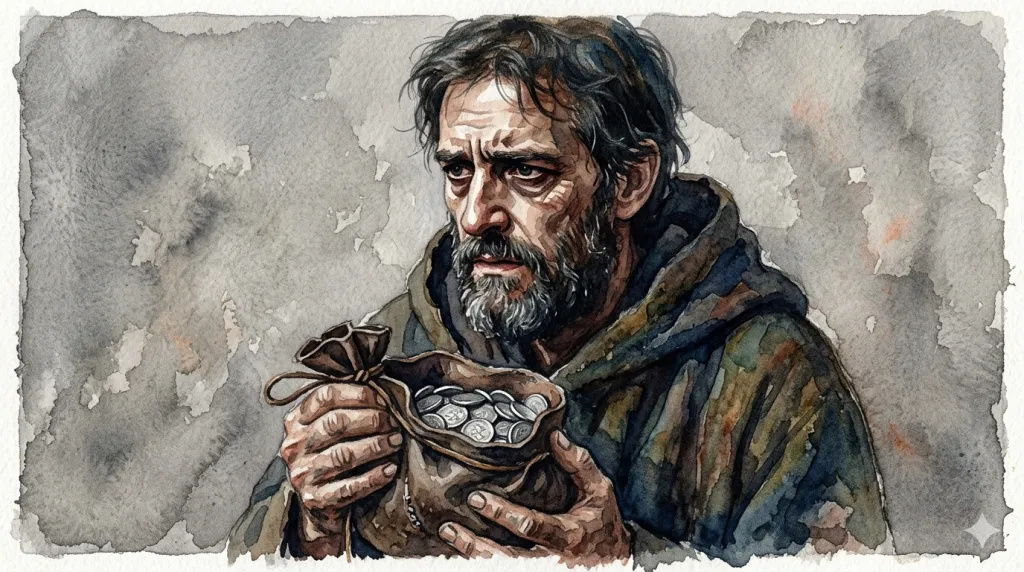

There are sums of money that don’t weigh heavily because of their intrinsic value, but because of the damage they cause. Thirty pieces of silver weren’t a fortune. They didn’t change a life. They didn’t buy a field or guarantee a future. They were, rather, an uncomfortably human price: enough to justify a decision, but not enough to silence one’s conscience. And that’s where the story of Judas Iscariot begins. Because sometimes we reduce him to a functional villain, the quintessential traitor, and that’s it, we close the case, as if understanding him were dangerous, as if getting too close to his humanity would force us to look at ourselves in an uncomfortable mirror.
But Judas didn’t start out as Judas. He started out as a man who followed Jesus Christ, who walked with Him, who listened to Him closely, who saw things that defied logic, who shared bread, weariness, nights, and doubts.
Yes, a man! A man who believed, or at least wanted to believe, and yet something inside him went wrong, not suddenly, it’s never sudden, but little by little, as everything important in life goes wrong: silently, without a fuss, almost without noticing.
Perhaps it was a disappointment that took root inside him. Maybe a Messiah who wasn’t what he expected. Perhaps it was even the frustration of seeing that the coming Kingdom had nothing to do with power, quick victories, or that human logic that demands visible results. Was it money? Fear, or the chaotic mix we all experience when something doesn’t fit the way we want? Because what’s unsettling about Judas isn’t that he betrayed; what’s unsettling is that one can understand—though not justify—the process.
Thirty pieces of silver! The number is almost symbolic, because ultimately it’s not about the amount but the moment, that fleeting instant when one negotiates what shouldn’t be negotiated, that second when the heart falls silent and the mind constructs a perfect narrative to explain the inexplicable. Judas didn’t betray Jesus for thirty pieces of silver; Judas betrayed himself, and that is far more valuable.
And then comes the weight. The aftermath always arrives. The inner turmoil that won’t subside, the conscience that no longer negotiates, the realization that this wasn’t the right path. And there, Judas becomes profoundly human again, because he can’t bear what he did, he breaks down, he returns the money as if that could undo the irreversible, as if the coins now burned in his hands.
There is something brutally honest in that gesture, not in the betrayal itself, but in the desperate repentance, in that belated clarity that arrives when there is no turning back on the deeds, but rather on how they are viewed. And yet, one detail always lingers, like an open wound in the story: Judas doesn’t stay, he doesn’t wait, he doesn’t allow himself the possibility of forgiveness.
While Peter also fails, also denies, also breaks down, but returns, weeps, and stays, allows himself to be seen again, allows himself to be rebuilt, Judas, on the other hand, leaves, and it is precisely there that we find the most painful difference, not in sin but in hope. Because if anything is unsettling about Judas, it is not only his betrayal, but his inability to believe that there was still a place for him, that even after everything, he could have been reached by that mercy he had seen so many times in others.
Thirty pieces of silver! Sometimes we think we would never do something like that, but we don’t realize—or don’t want to admit—that we all have our little coins, those moments where we exchange what is important for what is urgent, where we betray who we are to fit in, out of fear or for comfort, where we choose what shines in the moment even though we know, deep down, that it is not worth that much.
Are we like Judas? Perhaps we’re not so far off. And perhaps the invitation isn’t just to judge him, but to understand him so we don’t repeat his mistakes, or rather, so that when it happens to us—because it does happen to us on some level—we don’t do what he did afterward. To stay. To hold his gaze. To believe that even with the weight of the past still on our souls, there’s still a story that can be redeemed.

Juan Francisco Miguel
Juan Francisco Miguel es comunicador social, escritor y coach. Se especializa en liderazgo, narrativa y espiritualidad, y colabora con proyectos que promueven el desarrollo humano y la fe desde una mirada integral
Related

From Fear to Purpose: A Lesson in Mentoring and Personal Growth
Marketing y Servicios
02 April, 2026
2 min

Our Pilgrimage and Transition
Hugo Saldaña Estrada
31 March, 2026
3 min
How Big Is Your Faith?
P Angel Espinosa de los Monteros
31 March, 2026
4 min
The Silencing of Women’s Voices
Observatorio de Bioética UCV
31 March, 2026
13 min